
Packing list for ski tours
Take a look at the recommended packing list with packing tips from our mountain guides! The packing list for ski tours includes essential equipment for safety, comfort and emergencies.

We have put together our recommended packing list for ski tours. The first section is for tours with a mountain guide and the second section is what you should take with you if you want to go on your own adventure.
- We also offer great deals on ski tour hire equipment:
- Ski Rental Zueri
- Complete equipment, i.e. skis, boots, safety set, rucksack and poles
Flat rate of CHF 100 for 2 days and CHF 160 for 4 days. - You can add this to your shopping basket and collect it from Ski Rental.
- Complete equipment, i.e. skis, boots, safety set, rucksack and poles
- Sport Trend Shop Hinwil
- Touring ski package (touring skis incl. skins and crampons, touring boots, touring poles)
CHF 60 for one-day courses and CHF 80 for two-day courses - Package Safety (avalanche transceiver, avalanche shovel and probe):
CHF 20 for one-day courses and CHF 25 for two-day courses - You can collect this from the Sport Trend Shop with our booking confirmation and pay there. Please contact STS in advance to reserve the equipment. Collection on Friday and return by Tuesday.
- Touring ski package (touring skis incl. skins and crampons, touring boots, touring poles)
- Ski Rental Zueri
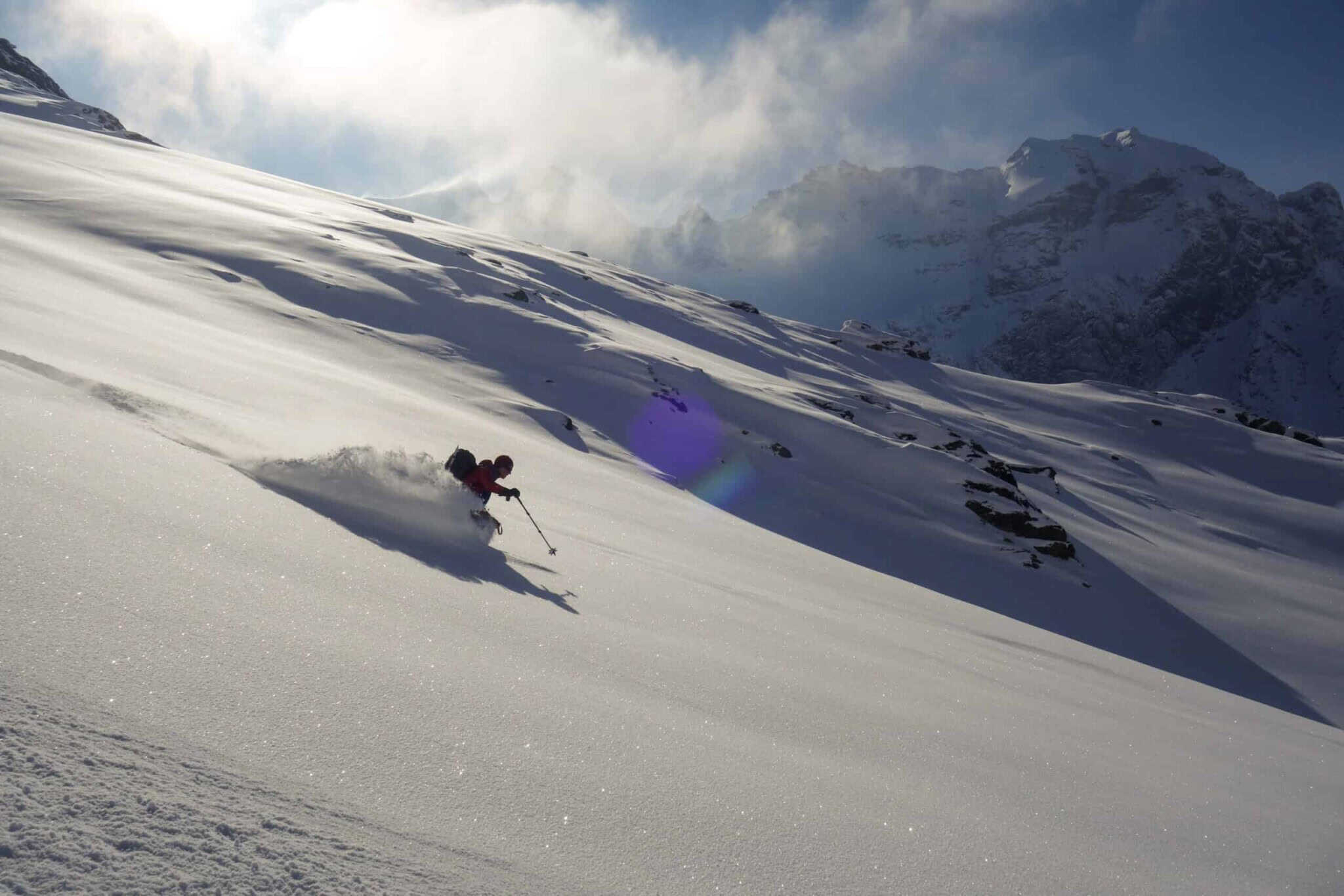
Your basic equipment for ski tours
So that you are optimally prepared for your ski tour, you will find our recommended equipment here. This list serves as a guide and can be adapted depending on the tour, weather and personal experience.
Clothing
Legs
- Ski touring trousers: Either breathable softshell trousers or Gore-Tex trousers for optimum protection in wind, snow or „huddle“ weather.
- Long pants (merino) for extra warmth on cold days.
Upper body
- Functional underwear & T-shirt: Breathable materials (e.g. merino). The avalanche transceiver belongs over the bottom layer, but under a layer of clothing, not directly on the skin.
- Midlayer / jumper: Warming layer made of fleece or wool.
- Warming jacket: Down or synthetic. Synthetics have the advantage that they stay warm even when wet and are produced more sustainably.
- Wind and rain protection: Lightweight, weatherproof hardshell jacket (Gore-Tex or similar).
Head & hands
- Cap and Headband
- Thin and thick gloves (change depending on temperature)
- Buff / scarf / face protection for windy days
- Sunglasses for the ascent (e.g. Julbo)
- Ski goggles for departure or bad weather
- Sun cream with a high protection factor
Feet
- Good ski touring socks: Preferably made from merino or functional material.
- Help with bladder problems Ezeefit-ankle socks or thin under socks as a second layer.
Equipment
- Touring rucksack (approx. 35 litres): With ski attachment (on the side, ideal for longer carrying passages).
- Touring skis with touring bindings: Pin bindings are light, reliable and tried and tested.
Tip: For individual advice or ski tests, talk to us on the way. For an exceptional wooden ski, you are welcome to contact us at Alpha wood drop by. - Skins & crampons: Wax or impregnate skins regularly to prevent them from swelling. If the glue no longer holds, glue kits (e.g. STS) can help.
- Ski poles: We recommend fixed length = more stable, lighter and more efficient ascent.
- Touring shoes: Fit is crucial - choose by feel rather than by brand.
Safety equipment
This equipment is essential on every ski tour obligatory:
- Avalanche transceiver (avalanche transceiver)
- Avalanche probe
- Avalanche shovel
Recommended additionally:
- Ski helmet: protects and keeps you warm.
- Avalanche airbag rucksack: especially when freeriding or on steeper terrain.
Catering & drinking
-
Thermos flask or drinking bottle:
For drinking systems, blow out the hose after use so that nothing freezes.
It is better to use a thermos bottle in cold weather. -
Lunch catering: Bars, nuts, sandwiches - energy-rich & space-saving. No Tupperware (takes up too much space).
Tip at the end
Don't be fooled by good weather. Always pack enough warm clothing in your rucksack. The weather can change quickly, especially in the mountains.
Practical:
You can also download our compact packing list for ski tours here as a Download PDF. Perfect for printing out or ticking off before the tour.
Overnight stays in huts
When staying overnight in SAC or other mountain huts, less is often more. Most huts are modernly furnished, have friendly staff and offer warm, delicious meals. So no need to take half your wardrobe with you;)
Here you will find what really belongs in your rucksack:
For the night
- Silk sleeping bag (hut sleeping bag): obligatory for reasons of hygiene and pleasantly light.
- Earplugs / earplugs: you rarely sleep alone in your room or camp.
Spare linen
- Fresh T-shirt and Underwear are completely sufficient. The touring clothing is comfortable enough to wear in the hut in the evening.
- A thin Jumper or fleece provides additional comfort during dinner.
Small & important things
- Sufficient cash: not all huts accept card payment.
- ToiletriesToothbrush, small tube of toothpaste, some soap or wet wipes. (Best in travelling size, saves space and weight).
Tip
Many huts provide slippers or Crocs. So you don't need to bring your own.
A small microfibre cloth is handy if you want to freshen up.
Independent tours
If you are going on a tour on your own, we recommend that you pack the following. Our mountain guides always have these items with them.
- a first aid kit with painkillers and bandages
- a repair kit for skis and bindings with
- Wire and string
- strong adhesive tape
- Cable tie
- Multitool
- Spare batteries for the avalanche beacon.
- a Rega radio or a satellite messenger. The device from Garmin, inReach miniis grandiose.
- a piece of rope for a short dicey spot
- A kit to make a makeshift rescue sled out of a pair of skis in an emergency.
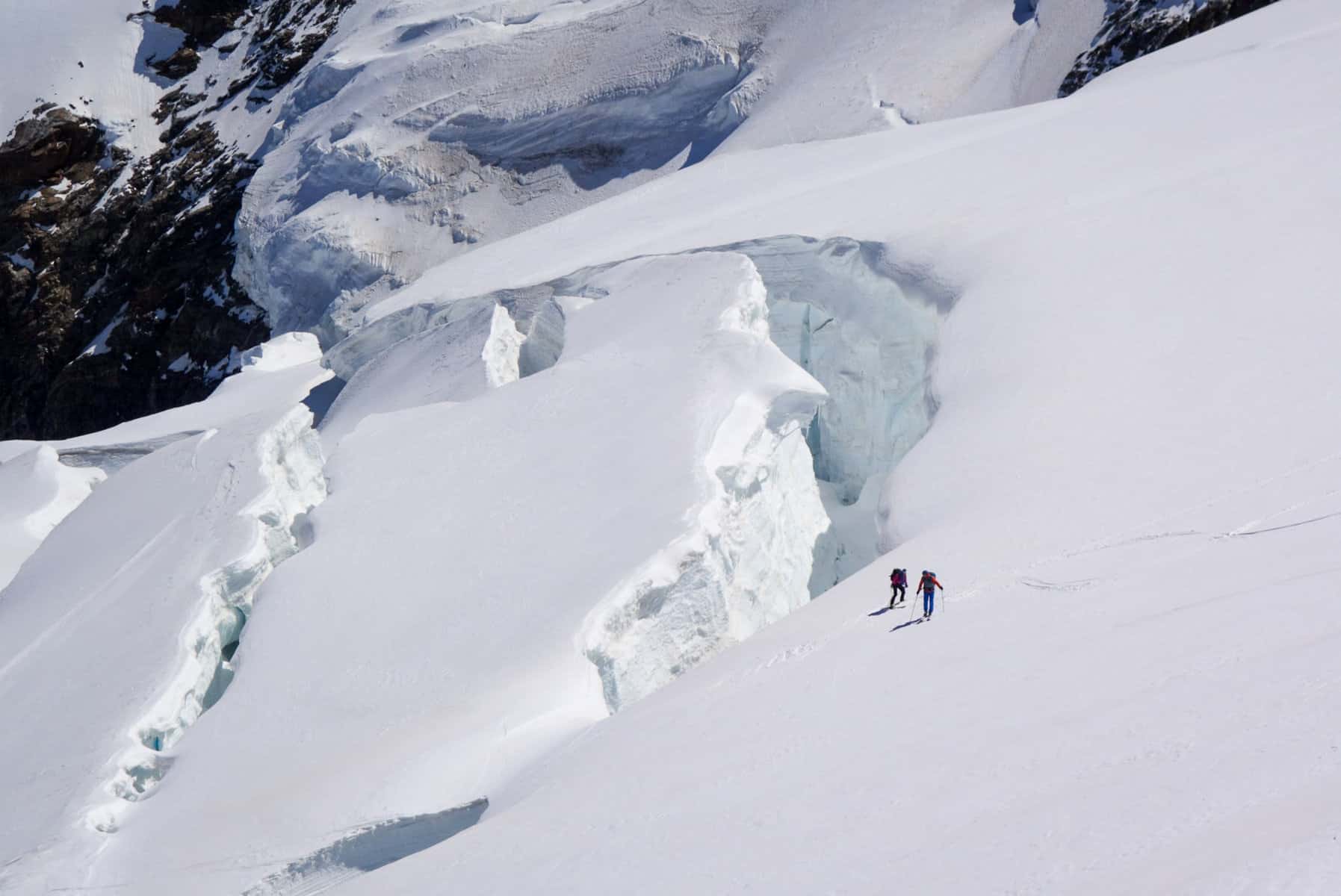
Additional equipment for glacier & high mountain tours
For tours in the high mountains or over glaciers, you need some additional safety equipment in your rucksack alongside your normal ski touring equipment.
This enables you to walk safely, rope up and handle alpine terrain correctly.
Technical equipment
- Ice Axe
Choose a model of moderate length. A pick does not replace a walking stick.
It is primarily used for securing in steep terrain and for short, icy passages. - Crampons with Antistoll
We recommend a model with a basket at the front and a clip at the back, so it fits both ski touring and mountaineering boots.
The anti-stud plates prevent dangerous snow build-up under the irons. - Climbing harness (Gstältli)
A light harness is sufficient for ski tours, as you are rarely really „hanging in the harness“.
It is important that it is easy to put on and take off even when wearing ski boots. - 2 screw carabiners
For fast and safe roping up on glaciers or when belaying in the terrain. - 1 webbing sling (120 cm)
Versatile in use: as a self-belay, for the belay station or as a prusik on a fixed rope. - Headlamp
For early starts and that special moment when you experience the sunrise over the mountains on the ascent.
Tip
If you don't regularly travel on glaciers, it's worth refreshing your ice axe, crampon and rope technique on one of our ski mountaineering or alpine touring courses. They are practical, safe and run by experienced mountain guides.
You can also use the packing list for ski touring download compact as PDF.
Questions and answers about the packing list for ski tours and ski touring equipment ?¿
Can ski touring skins be waxed?
Yes, and they have to be from time to time. Either you use a normal wax block or one especially for skins, it doesn't matter, and coat the skins vigorously in both directions with the block. Alternatively, you can impregnate the skins with a spray. The wax or spray impregnates the skin. This makes the skins glide better and reduces the formation of studs on the skins.
Is a softshell jacket better than a hardshell jacket?
A softshell jacket is just a slightly better pullover. It is windproof, but not waterproof. We actually always use a waterproof hardshell jacket in the mountains and don't own a softshell jacket at all. But if you like the softshell jacket, it is of course also a good piece of clothing!
Is a ski tour possible with normal ski boots?
Yes, but not recommended for longer time or longer tours. Modern ski touring boots are very comfortable and offer a great range of movement. The ascent is much more pleasant with ski touring boots. For the descent, ski touring boots are sufficiently stiff. For a short familiarisation tour, normal ski boots are okay.
Is a special backpack necessary for ski tours?
A normal backpack is quite sufficient for ski tours. For high-altitude ski tours, you need to be able to tie the skis onto the backpack. Ski touring backpacks often have a separate compartment for shovel and probe and good devices for tying the skis on. There are also avalanche airbag backpacks. However, these are mainly recommended for freeriding.
How does a ski touring helmet differ from a ski helmet?
A ski touring helmet is somewhat lighter and more compact. Especially the area around the ears is typically flexible in a ski touring helmet. Climbing helmets that also meet the ski touring standard are also suitable for spring.
What does ski touring equipment cost?
For ski touring equipment you have to reckon with about the following prices:
- Ski set with binding and skins: 1000 - 1500.-
- Ski touring boot: around 700.-
- Safety Set with avalanche transceiver, shovel, probe: around 400.-
A good address for used equipment is the Second-Peak in Zurich.
What is the usual centre width for a touring ski?
A good all-round touring ski has a centre width of about 95mm.
What should I look out for when buying a touring ski?
Modern touring skis are rockered, i.e. they have a long shovel. Therefore, you should buy touring skis that are about your body size. Another important aspect is the width. An all-round ski has about 95mm width under the binding. Powder skis, or downhill-oriented skis for deep snow, are often somewhat wider. For Switzerland, however, it is not really worth going beyond a centre width of 110mm. Slightly narrower, approx. 88mm wide, somewhat lighter and more agile skis are suitable for spring. The weight you carry uphill also plays an important role. It is better to save a little weight on the binding and buy a slightly heavier ski. A good value for the weight is about 1.5kg per ski.
How heavy should touring skis be?
Good touring skis weigh about 1.3-1.6kg, depending on the length and width of the ski. It is better to use heavier skis with a very light binding.
Which skis are ideal for ski mountaineering?
For high-altitude ski touring, where the snow is either hard or nice and slushy, we recommend slightly narrower and somewhat shorter skis, about 88mm wide under the binding and a few cm shorter than your height. Nice and light, as high altitude ski tours are usually long.